[SECTOR 47] • DRADIS: CLEAR • FTL: STANDBY • COMMS: OPEN

Popagandhi

punk rock since 2003

Home About Bikes Photos Food
  • Akhuni

    Published on June 14, 2020

    I could not believe my eyes when my wife Sabrena put on an Indian movie on Netflix and we saw at least two Northeast Indians at once. On screen. Having lines. Being whole people. Doing something. Something that seemed important.

    "Axone" (pronounced Akhuni) - is a Naga speciality dish made with fermented soya beans. It is said that Nagas, especially those from the Sema tribe, know when axone is 'done' simply from smelling it: its smell carries memories of home, which tastes of the umami and salty goodness that any soybean-eating peoples can identify immediately, from smell.

    Unfortunately, not everyone in Delhi's Humayunpur neighborhood is a fan. Despite being frequently described as Delhi's "Northeast district", given the abundance of Northeastern and Tibetan people, shops and restaurants, there is a fine line between tolerance and acceptance. Like any other 'ethnic neighborhood' in Delhi, you can have lots of people from one area yet still be divided by thousands of invisible segregating lines.

    Axone, by Shillong-raised Nicholas Kharkongor, carries the weight of all of the eight Northeast Indian states on its shoulders.

    You are from here - when it makes sense for you to be; but not from here - when it becomes convenient.

    The central conceit of the movie, and its title, lies in the idea of a group of mixed Northeast Indian friends who have found community and love among each other, living in the same area. For all intents and purposes they seem to be regular folks with regular lives. Chanbi, performed by Manipuri actress Lin Linshraim, is gregarious and opinionated. When a Delhi boy in the neighborhood mutters the sexual vulgarities they typically reserve for 'Northeast / Nepali sluts', she, like any other Northeast woman who has spent too much time in Delhi, confronts him. Her boyfriend, Bendang, recoils and says he did not hear that comment. Maybe it's a statement about how even a stone's throw from Delhi's most affluent southern neighborhoods, the pecking order is clear: Delhi boys will always be backed up by Delhi fruit-sellers (even those from UP), who will always be backed up by random neighborhood uncles on the street who will demand proof from bystanders before he lends his commentary and judgmental weight towards resolving an untoward situation; then the others, like the 'Chinkys', and even then the smaller in every way Northeastern man cowering behind his authoritative girlfriend will get more of a say than she does.

    He does not pull his weight. It's clear from the moment he does this that there is some kind of trauma around being a not-very-large Northeastern man in Delhi and street violence. Everything in his eyes says so. Immediately, I thought this might have something to do with Nido Taniam: the Northeastern man from Arunchal Pradesh who was beaten to death by shopkeepers in Delhi's Lajpat Nagar. His crime: being a chini - who dared break a glass counter in a fit of rage, after they made fun of his blonde, spiky hair. There are many reasons one might want to stand down from a fight that's percolating on the streets of Delhi. Especially so when you are from the Northeast.

    Before we find out anything further about this trauma, or even about Bendang as a person, there's a lot of ensuing chaos around the cooking of this dish. We're told it's special, it's for a wedding. We can tell that people don't like it, and the Northeastern crew know that. They go door to door telling those who will maybe grudgingly accept this, like the African neighbor who says that dish smells like shit (but we never find out more about her other than that the 'Nepali' person can't pronounce her name either); but plot to complete this cooking between the time someone's grandma's nap and the Bengali auntie's return. Maybe it makes a point that this part of Delhi is indeed a very large pot of various things, but that melting pot it is not. It's clear who calls the shots: Dolly.

    In nearly every multicultural society, a minority group cooking something that looks, tastes, smells, or simply just is - different is an affront. Sukehtu Mehta, who made the journey several times between being 'from here then not then here again but not really', talks about having his native food being made fun of in New York City, then supposedly insulting militant vegetarians in his upmarket South Mumbai home, with his meat-eating. In Singapore, where I am originally from, you can be simultaneously refused an apartment for being of an ethnic background that is most likely to 'stink up the house with the smell of curry' (link) and defended for cooking curry (only if the people who complain are other foreigners, like... newcomers from China).

    There is a lot of yelling in this movie. As an autistic woman who hates yelling, it was hard to watch at times. But it also helped me understand why Delhi was such a difficult place for me to be in. All that yelling. There is also a lot of scurrying.

    For a slice-of-life dramedy, Axone hits the mark. Things go wrong, things keep going wrong; protagonists try to fix it, they don't; they keep trying, they give up. In between, there is a lot of intra-community anxiety to unpack. She doesn't like you, you're Nepali, not a real Northeastern person. What happened to this once jovial man, now a shadow of his former self? At every turn it feels like an explanation. This is what a Naga person would face in Delhi. This is how a Tibetan person would experience the nation's largest, some would say most unkind, city. - The big reveal about Bendang's past was so thoroughly unsurprisingly, yet so insufficiently explained. I wish the film took more time to explore Bendang's horrific past, than it did to explain how hurt someone felt later when he was called a 'f—king Indian'.

    Things that were great

    #
    • The cast: mostly strong actors all around, representing various parts of the NE, Nepal and Tibet
    • The anxiety around the cooking of this dish: on top of it being the biggest day of one's life, there is also extreme racism and terror
    • The true-to-life explanation of the panic-inducing daily life folks in the NE community face in Delhi; how many micro-aggressions they face
    • All of the cultural moments: anything that zoomed in on the cooking, speaking and rituals of NE traditions. My favorite moments were when all the friends spoke in a different tribal language at once to try to sort out some jugaad
    • Overtures to the musical and Christian traditions of parts of the Northeast: I suppose it's hard to strike a balance between 'celebrating the musicality of Northeast Indians' and 'extending the stereotype that every Northeastern man simply likes to strum a guitar and sing idly'
    • Struggles with Hindi: you can never do well enough at it. You either struggle to sing a standard Hindi song, or you yell at people in a market but still get 'translated over' because people think you don't speak Hindi because you are a Chini
    • The exasperating role of Shiv, despite being grating, was a perfect example of a wannabe liberal Delhi dude who wants to be an ally but ends up missing the plot anyway
    • The actual wedding itself: unexpectedly fun

    Things that were not

    #
    • Screen time: most of the screen time was devoted to a very good (but also Bengali) actress; and to another Tibetan Indian actor. As others have pointed out, it was odd that the most famous actor of the cast, an actual actor from Assam (Adil Hussain) was relegated to such a minor and somewaht problematic role
    • Extra attention on Lin Linshraim and Lanuakum Ao's characters (Chanbi and Bendang) would have greatly improved the movie
    • Too much of the movie was a 'soft' commentary on the racism faced by the NE community. 'You failed to have any Indian friends', someone scolds a partner, who is clearly still recovering from having his life nearly taken from him over the color of his hair

    Like any movie that is 'first' with representation, there were big shoes to fill that ultimately led to disappointment. Must every minority movie be a masterpiece? Should every minority movie hit every note without going out of tune? Watching this movie as a Chinese-Singaporean person in America who has been disappointed by most Asian-American outings to Hollywood, I felt similarly about Axone. So much potential, so much talent. So little punching above its weight.

    Like many Asian-American movies, this one is not quite clear who its audience is. It's most on shaky ground when it's trying to be both - a statement of NE pride and culture, and - a film that is palatable to a movie-goer in Mumbai or Delhi. It's strongest when it is unabashedly Northeasthern: here is the food, it makes a Sema Naga person happy on the happiest day of her life, and here is the awkward group of other Northeastern friends who will go to these lengths to make her happy. Even if Dolly thinks it's a bloody costume parade, or that all of it smells like shit.

    More of this, please. But also with an extra helping of all of the smelliest things that others may not like.

    (Axone is streaming on Netflix.)

    movie (view all posts tagged movie) review (view all posts tagged review) northeastindia (view all posts tagged northeastindia) India (view all posts tagged India) nagaland (view all posts tagged nagaland) food (view all posts tagged food) race (view all posts tagged race)
  • We Got Married

    Published on June 13, 2020

    If you are a queer person in Asia, like I was, moving away and starting a family might be top of mind as something you should do. To be fair, I did not feel extremely oppressed, I did not often face homophobia, and I generally felt like I could do whatever I wanted to do as a queer person in Asia. For a long time, that was fine.

    I soon learned that was fine because of the following:

    • I am Chinese
    • I am upper middle-class
    • I am English-speaking
    • I have one of the best passports in the world
    • I can afford all of the 'hoops' that we are supposed to jump through in order to live a decent queer life back home, literally

    At some point, it did not feel viable for much longer.

    A big part of that is that I fell in love with a person who, despite being half-Singaporean, despite having been in Singapore for a decade, was never going to be able to get a long term visa there. We could marry, of course, abroad, but... what would that matter, to our life in Singapore? Singapore would not recognize that marriage. They might ignore it, and not actively diss it, but that's not good enough. Especially for people with our privilege.

    So, like queer folks with any amount of privilege, we left.

    To do that, we had to fly to New Zealand.

    Our marriage was solemnized by a Maori woman who ordained our marriage, as our wedding celebrant.

    And with that, we were off. Less than six weeks later, we were in our cute little studio in downtown San Francisco, dog in tow.

    We Got Married
    We Got Married

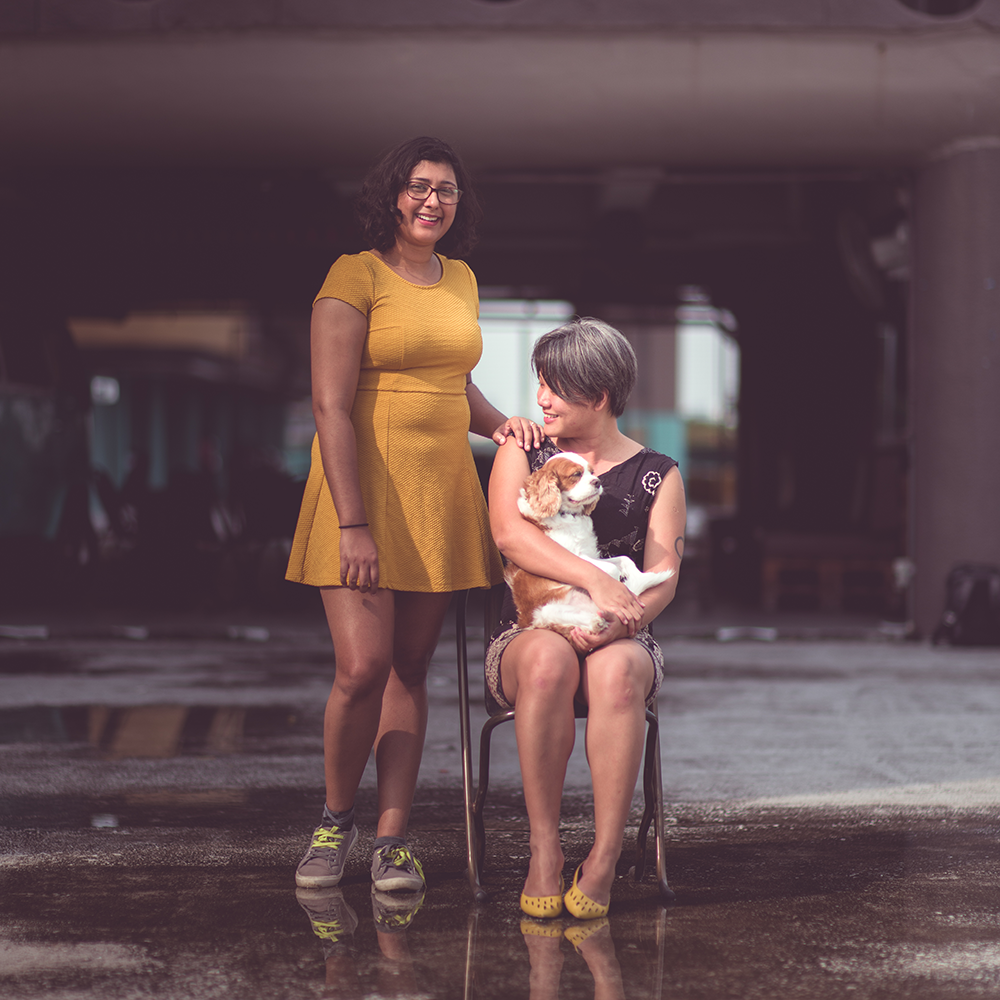
    One of the last photos we took before leaving Singapore, in our favorite place: Golden Mile. Photo by our good friend, Javad Tizmaghz, photographer and woodworker extraordinaire.

    I wish we didn't have to leave at all.

    Very often, when you move to America, the prevailing thoughts are:

    • You must really want to come here
    • For a better life
    • You must want a green card
    • You can't wait for a US passport
    • Things are so much better over here

    But in the age of fascism, are those things still... true?

    Things that are not better

    #
    • Food
    • Having to walk 2 blocks to do laundry
    • Having to pay $$$ for the right to stay
    • White supremacy
    • Not being able to leave for a while, until we sort out our plans here
    • Public transit
    • NIMBYs
    • Lack of skyscrapers
    • Far from loved ones

    Things that are better

    #
    • The state recognizes our marriage
    • Our pets thrive in a lack of humidity
    • The so-called local govt incompetence, to some right-wingers, is actually an engaging exercise in consensus-building, for these not-right-wingers
    • Adopted family

    How to get queer married

    #

    First, decide which country you want to get married in. If you have a good passport, then just select the best ones that will marry you, and whose scenery you enjoy the most. If you don't, then select the country that will admit you without a visa, or with an easy visa, that will also marry foreigners.

    Second, ask your beloved if they will marry you. In my case, I asked my wife-to-be to marry me at 5 in the morning at an airport. She said yes, thankfully, despite being sleep-deprived.

    Third, make the necessary online reservations. Most cities or counties that will marry you require you to book an appointment online. In our case, we made a booking on NZ Marriages. It was very easy, and affordable, and I highly recommend it. Also, are the Kiwis the last competent people in the English-speaking world? (I think so.)

    Fourth, once you have received confirmation, book your trip! In our case, we had plenty of points from Singapore Airlines and we were able to splurge on a business class trip down south.

    Fifth, locate marriage witnesses. Thankfully, we had a few of those. One of them was a Finnish journalist I had never met, but had followed on Twitter for years; the other was... I completely forgot this, my ex-girlfriend's girlfriend's... ex. My wife-to-be asked on the morning of our wedding how we knew each other, and we burst out laughing.

    Sixth, be happy. Not everyone has the ability to move somewhere where their marriage is going to be recognized. I certainly did not think it was a big deal, until I had that privilege. We have so many friends who live in various parts of Asia, who have fought different battles. Maybe you are Menaka Guruswamy and Arundhati Katju, and together as a couple you strike down a Victorian-era homophobic law that has been used as a cudgel against gay men in India. Maybe you will be inspired by my Malaysian lesbian friends, @zhukl, who fights homophobia, misogyny and other bigotry on a daily basis.

    We got lucky. I had the opportunity to take my skills somewhere that wanted it; luckily, they wanted my wife too. On so many levels, it's worked out to be a step in the right direction for us. I have a job that I love, that is fulfilling; my wife gets to restart college after a series of mishaps.

    It has been a whirlwind. As an international queer couple from so many places, here are some of the things we must consider:

    • If I die, what visa will my wife have?
    • Where will she go, if not here?
    • If we have children, what citizenship will they possess?
    • If we have children, and I die in Singapore, what inheritance will they receive (when the country does not recognize our... family?)
    • If 'Murica gets worse than it is (and this is just news from this week), where will we go? Who will want us?
    • If there is a civil war, what will it be like for us as non-citizens?
    • How will we move our pets quickly?
    • If I have to move home to Singapore, how will she stay?
    • If we have to go to France, where she grew up, how will I ever be able to function at 100% as a person with zero interest in western Europe, its society and its languages?

    We're thankful that we are now somewhere that makes some sense to us.

    How much longer will it continue to make sense, though? Who knows. Maybe the next seven months will tell.

    life (view all posts tagged life) covid19 (view all posts tagged covid19) coronavirus (view all posts tagged coronavirus) family (view all posts tagged family) love (view all posts tagged love) pets (view all posts tagged pets) quarantinediaries (view all posts tagged quarantinediaries) pandemic (view all posts tagged pandemic)
  • Blogging in 2020

    Published on June 13, 2020

    Why don't we blog anymore? I don't know.

    In 2003, I certainly was, and I had been for a while. I started my blog on Greymatter CMS, then Movable Type. At some point, B2, then Wordpress. Blogger got sold to the Borg (Google); LiveJournal.. what happened to them? They were so cool. Tumblr felt inane to me, an Internet grump by that time. And then we just gave up. I did, anyway.

    For a long time, it felt like the ability to post anything online was going to change the world. In so many ways it has. The jury is still out on whether that's a net positive. It certainly isn't the runaway democratic success we all imagined. Big media chased the sexiest things on the web, which instantly made it no longer so. Tech companies we adored grew into gargantuan beasts that disappointed us, more and more. Software ate the world, and then spat it all out, without masticating.

    I was certainly not immune.

    Sat rapt by the beauty of technology intersecting with a rapidly changing world, brought closer together by low cost airlines and closed quickly by new age fascist dictators, I don't know if I've really had a moment to breathe, or think, in the last decade. Most of the blame falls squarely on my profession of choice: for a while, those of us somewhat proficient in the use of computers believed that we could change the world with... computers. Our children may laugh at that naïveté.

    At 35, I care about many different things now. As an immigrant, my ability to say F-everything has reduced by magnitudes. I feel like everything has changed, but I am still the same person. Maybe a little bit emo, maybe a little bit brash.

    Most of all, I feel like writing again. So here goes, again.

    life (view all posts tagged life) covid19 (view all posts tagged covid19) coronavirus (view all posts tagged coronavirus) family (view all posts tagged family) love (view all posts tagged love) pets (view all posts tagged pets) quarantinediaries (view all posts tagged quarantinediaries) pandemic (view all posts tagged pandemic)
  • Love in a Time of Quarantine

    Published on March 18, 2020

    The last few months have been all about the virus. Having lived through SARS and several other viruses growing up in Singapore, I wasn't particularly worried at first.

    Now, it's clear the best way to deal with all of this is too impose extreme social distancing measures. Where I live, in San Francisco, we haven't gone full lockdown the way the European countries and Chinese cities have; we've implemented, instead, a 'shelter in place' policy. Stay home unless you have to do something essential; activities like walking and biking, doing laundry, going to the bank, are still allowed.

    There was of course a run on the supermarkets and grocers. Despite many of my cynical compatriots in Singapore originally attributing this behavior to Singaporeanness (after all, 'kiasu-ism' is a known trait of ours, and a way of life), this turned out to be global behavior. Everyone wanted toilet paper, lots and lots of it. Everyone wanted hand sanitizer, masks and disinfectant as well.

    We didn't really do any of this prep until a few days ago. After all, my greatest fear is that I might run out of flavor and of Asian cooking ingredients. So I didn't really care, until... I saw that tofu was briefly unavailable. That's when I really started to worry.

    As part of my work, I get to be involved in some of the tasks around helping San Franciscans find out more about what's going on (I lead a few teams, and one of them is in charge of SF.gov, the main city website). It has been impactful to know that the work that we do, that we have done everyday, has contributed towards helping people get timely and accurate information in an easily understood manner. I'm so proud of what we've done. In such times (of high stress and anxiety), words really matter: I am a highly anxious person, so I am aware of how sometimes words make all the difference between feeling better and feeling like you're going to meltdown. We've worked to break down complex information, and to ensure that everyone (including those who speak other languages) is able to read this and come away with the sense they know what to expect.

    On the home front, being home most of the day with Sabrena and the pets has been fun, although I now wonder if I need a second TV. In times of high anxiety, I binge-play video games to feel better; that's not logistically friendly in a studio with another person.

    Not commuting daily, even if my commute is a 20 minute walk, helps me prep and cook fancier meals. In moments of crisis, I need to know that I have nice food. Spending an hour making something quite elaborate helps me calm down. So far, I have been steaming fish with Nyonya spices, making tempeh and pecel vegetables, many types of soups and congees. I expect to have a huge photo album of 'quarantine food' at the end of all this. It is unlikely that album will look anything like quarantine food, as long as I still have access to my butcher, fishmonger and farmer's market.

    Meanwhile, I am depleting my supply of good tea, so I must do something about that.

    life (view all posts tagged life) covid19 (view all posts tagged covid19) coronavirus (view all posts tagged coronavirus) family (view all posts tagged family) love (view all posts tagged love) pets (view all posts tagged pets) quarantinediaries (view all posts tagged quarantinediaries) pandemic (view all posts tagged pandemic)
  • Envelop SF

    Published on January 21, 2020

    When we first moved to San Francisco, I was excited to have a new environment but I was not sure I would enjoy the city as much. My previous visits to the city had been mostly work/tech related. While I love many of my co-workers and friends in big tech and in startups, parts of San Francisco felt.. like a tech mono-culture.

    Consciously going out to things and meeting new people, making friends with people who have interests outside of tech, through sports, volunteering or music activities, has changed my relationship to this city.

    In this series of posts, I will write about the events, venues and activities I have enjoyed in San Francisco.


    Music used to be a huge part of my life. From the time I was six or seven, I was in band practice or piano lessons a few times a week. Without music, my life might have turned out different. Not having much music in the last decade or so was a terrible idea, so I'm now furiously trying to get it all back. Piano lessons, jazz clarinet lessons, going to shows, meeting new friends who also like music... I have enjoyed the access to top musicians and teachers, and to excellent shows of all genres nearly every single day.

    Envelop SF popped up on my radar when I was looking for music events: they were hosting a Flaming Lips listening party for Zaireeka, the band's 1997 experimental album that I'd never heard (mainly because in 1997 you needed to put 4 CDs in 4 players and press play all at once).

    Envelop SF
    Envelop SF
    (*image from [Envelop](https://www.envelop.us/software)*)

    At first, I had no idea what these shows were. Were the Flaming Lips in town? Was it a live show? It was actually cooler than that. Envelop is a non-profit that runs an immersive audio venue in the lower Dogpatch (and another one in Salt Lake City, with popups and satellites elsewhere).

    I don't know much about audio engineering or sound design, or what 'spatial music performances' are, but as I attended their session for the Flaming Lips' Zaireeka I quickly became a fan.

    The venue in San Francisco is in a tiny space in an industrial area near the Dogpatch, with dim lighting, and ambience that reminded me of a yoga studio mashed up with a private DJ set. 32 speakers at the venue are positioned in a sphere, with the audience seated on foldable chairs on the floor, surrouned by said speakers. "The entire room is an instrument" was the experience they promised, and it really did feel that way. This immersive experience is powered by their open source audio software that works with Ableton Live 10.

    A trust-based minibar rounded up the experience by providing for the wine, beer, tea and water you might want to sip while listening to music.

    While I was initially confused by why I might want to experience 'spatial music', I came away from it a fan. I think it would be a good way for a music lover to experience music they know and love in a totally new way, with audiophile technology that would be difficult to create at home. I plan to listen to Miles Davis, Pink Floyd and Coltrane there as I think their music can be experienced differently in this environment.

    Next week, jazz shows with new jazz friends. Jazz hands!

    sanfrancisco (view all posts tagged sanfrancisco) exploringthecity (view all posts tagged exploringthecity) music (view all posts tagged music) events (view all posts tagged events)
← Previous
Page 12 of 39
Next →

Search

More

  • Now
  • Writing
  • Elsewhere
  • Archives
  • Tags

Blogroll

  • Winnie Lim (opens in new tab)
  • Anil Dash (opens in new tab)
  • Chronosaur.us (opens in new tab)
  • Jason Li (opens in new tab)
  • Andy Bell (opens in new tab)
  • Robin Rendle (opens in new tab)
  • Emily's bike stuff (opens in new tab)

© 2026 • Contact • GitHub (opens in new tab) • Mastodon (opens in new tab) • RSS